Quick answer
Most kapok pillow pages describe the cover and the care. Few describe the kapok. Of 24 makers' pages read on 2026-11-11, every one named the cover fabric and nearly all gave care steps. Only 13 said how much of the fill is kapok, 5 gave the fill weight, 5 named where the kapok comes from, and 1 named a certificate with its number (survey data).
This guide is for: people comparing kapok pillow listings who want to know which facts a page gives and which ones they will have to ask a maker about.
Key Takeaways
Three counts from the survey: how often pages give fill weight, the cover against the kapok share, and how often a certificate can be checked.
- 5 of 24 pages state the fill weight, the figure that tells you how full a kapok pillow will be (survey data).
- Every page says what the cover is made of, but only 13 of 24 say how much of the fill is kapok (survey data).
- 1 of 24 pages names a certificate with a number you can look up yourself (survey data).
What does the count show, question by question?
Pages describe the cover and the care far more often than the kapok: its share, origin and weight appear on a minority of the pages read.
We read 25 listed product pages for kapok and kapok-blend pillows sold to US buyers, all on 2026-11-11 (survey data). On each question, every page went into one of three buckets: it states the fact, it says nothing about it, or it could not be read. One page would not load in a readable form, so each share below is out of 24. Pure-kapok pages and blend pages got the same questions, and the rows run from most often stated to least often stated.
| Question asked of each page | States it | Silent | Not readable | Share of readable pages |
|---|---|---|---|---|
| Says what the cover is made of | 24 | 0 | 1 | 100% |
| Gives care or washing instructions | 22 | 2 | 1 | 92% |
| Says where the pillow is made | 17 | 7 | 1 | 71% |
| States how much of the fill is kapok | 13 | 11 | 1 | 54% |
| Says where the kapok comes from | 5 | 19 | 1 | 21% |
| States the fill weight | 5 | 19 | 1 | 21% |
| Names a certificate with its number | 1 | 23 | 1 | 4% |
Source: kapokpillows.com survey CSV, read on the survey day. Shares are of readable pages, rounded to the nearest whole percent.
Almost every page covers the outside of the pillow, and far fewer cover the fill. Every readable listing names the cover fabric. Far fewer give the kapok's weight or where it comes from. If those are the details you care about, you will have to ask the maker on most listings.
How were the maker pages read, and where does the count stop?
Each maker's own page was saved as read on one day, and a yes needed a quote from the page. Claims were recorded, never verified.
Every page in the count was the maker's own product page for a pillow sold to US buyers. Each was saved exactly as it read on the survey day. A question scored a yes only when a quote in the saved page supported it. Vague wording did not count. A page that said "natural fill" and gave no share, for example, would score silent on the share question. Every yes records what a maker said. The count does not check whether any of it is true. Nothing was opened or handled.
That sets the limits. The count tells you what a careful reader of these pages is told. It cannot tell you whether a stated weight or origin is correct, and it says nothing about makers who were not on the list. It covers one day. Pages change, so a page that is silent today may say more next month. The sewn-in tag, or a reply from the maker, may hold facts the page leaves out.
Why does fill weight matter when so few pages give it?
Fill weight tells you how full a kapok pillow will be, and only about one page in five states it, so most listings leave its height to a guess.
Fill weight is the number that tells you how high and how firm the pillow will sit under your head. More kapok in the same case makes a taller, firmer pillow, and less makes a flatter, softer one. Few pages stated a fill weight (survey data). That leaves most shoppers guessing. The law label may carry it. Before you order, ask the maker for the weight in ounces. If you are coming from down, our guide on using kapok in place of down covers how much fill to use.
The table below is our own judgement of what each missing line costs you. No maker publishes anything like it.
| Line missing from the page | What you cannot check without it | How much it matters (our judgement) | Where else to look |
|---|---|---|---|
| Fill weight | How full the pillow will be | High | The law label, or ask the maker |
| Share of kapok | Whether the fill is pure or a blend | High | The law label, which names each filling and its percentage (Connecticut DCP) |
| Where the kapok comes from | Which crop you are buying | Low to medium | Ask the maker |
| Certificate number | Whether a certificate is current | Medium | The certifier's own lookup (OEKO-TEX) |
| Where the pillow is made | Who assembled it | Low | Imported textiles must name a country (FTC textile rules) |
What does a page mean when it says how much of the fill is kapok?
A share line tells you whether the fill is all kapok or a blend. Just over half the pages read give one, and the rest leave the mix unstated.
A share line is the page saying what portion of the fill is kapok. It might say "all kapok," or it might give a split with another material. Just over half the pages gave one (survey data). Blends are real products: one maker sells a refill it describes as half kapok and half shredded latex, the same blend it uses in its body and pregnancy pillows (MINICAMP refill page).
A page that says "kapok pillow" without a share does not tell you whether kapok is most of the fill or a small part of it. You can settle that by asking the maker one question in writing before you order. Keep the reply. A written answer is easier to hold a seller to than a vague phrase on a page.
The sewn-in law label is the other place to look, since it names each filling and, in a blend, the share of each. For background on the fiber itself, see what kapok is and where it comes from.
Where does pillow kapok come from, and how many pages say?
Most traded kapok has come from Indonesia and Thailand, yet only about one page in five names where the fiber inside the pillow was grown.
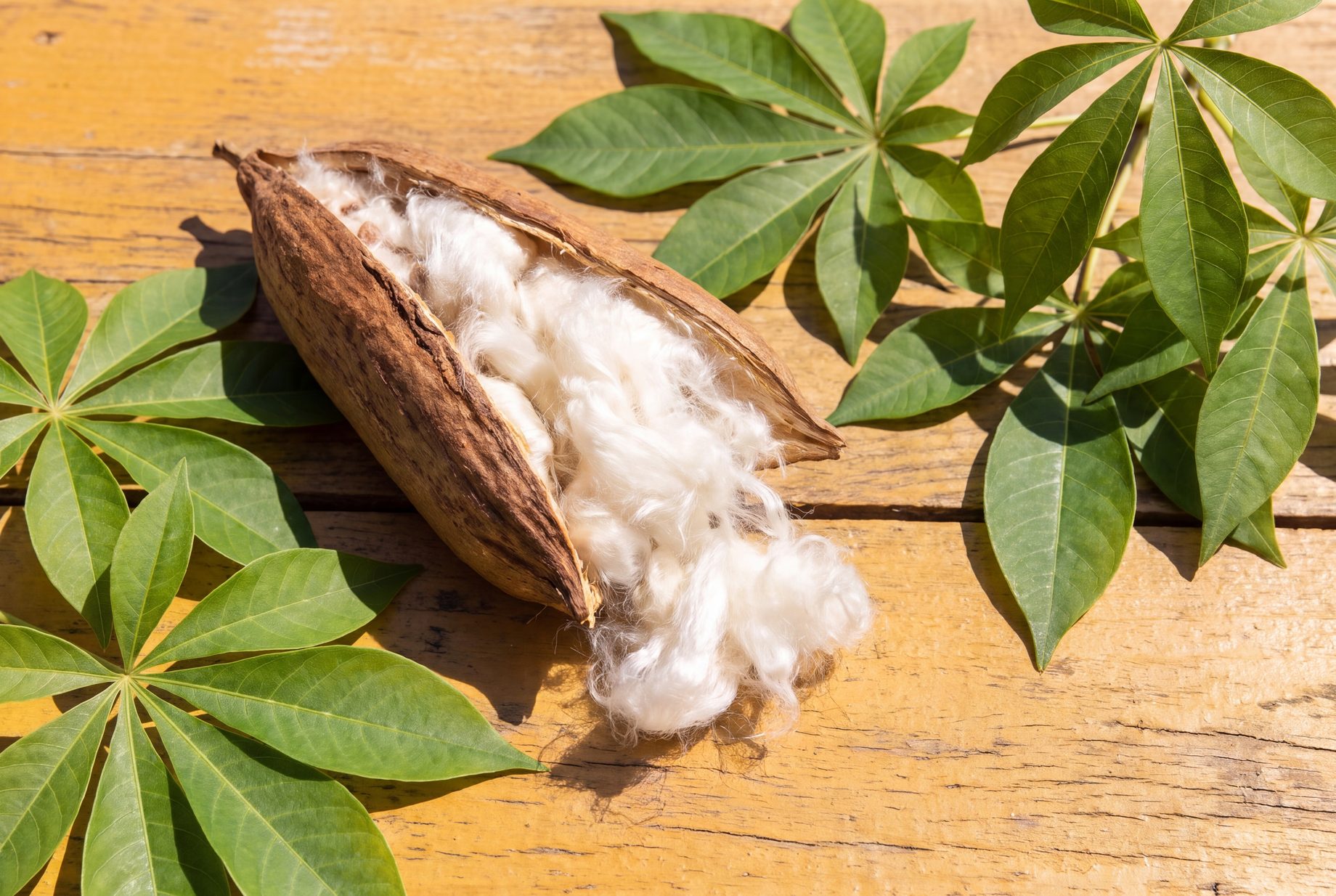
Kapok grows in the seed pods of the kapok tree, and most of the commercial crop has come from Southeast Asia. A regional plant handbook puts Indonesia's yearly output well above Thailand's, with Thailand's holding steady (PROSEA). Even so, few pages said where their kapok came from (survey data).
One page that does name a source points to the Brazilian rainforest instead (CozyPure product page). The survey recorded that origin as written on the page and had no means of confirming it.
Keep two places apart in your head: where the kapok grew and where the pillow was made. Many more pages said where the pillow was sewn than said where its fiber was grown, so a pillow made in the US can still be filled with imported kapok. The made-in line answers the second question, not the first. If origin matters, ask the maker.
Why does a certificate claim need its number?
A certificate name without its number cannot be looked up. One page in the count named a certificate with its number, and the rest did not.
You can only check a certification claim if you have the certificate's number. OEKO-TEX, which calls its label one of the best known for textiles tested for harmful substances, tells shoppers to scan the label's QR code or enter the certificate number in its Label Check tool (OEKO-TEX). Without a number, you have nothing to enter. Just one page in the count named a certificate together with its number (survey data).
A page that named a certificate but gave no number counted as silent on this question. A bare name cannot be looked up. This guide does not reprint the one number it found, or any other.
If a page says a material is certified, ask the maker for the certificate number and look it up yourself. Then read what it covers. A certificate for a cover fabric tells you nothing about the fill inside it, so make sure it covers the part you care about. A current certificate that covers only the case is still worth knowing about. It just answers a different question from the one this survey asks about the kapok.
What do the cover, care and made-in lines leave out?
Cover, care and made-in lines are the most common facts on a page, but the three lines tell you little about the kapok's share or origin.
Pages are most complete on these three lines. Every readable page said what the cover is made of, nearly all gave care steps, and most said where the pillow is made (survey data).
A care line tells you how to clean the pillow you buy. The count recorded only whether a page gave one, not whether the advice is sound. Follow the care steps on the page or tag for your own pillow rather than a general rule you read elsewhere. For what water does to the fiber, see can you wash a kapok pillow.
| Common line | What it tells you | What it leaves out |
|---|---|---|
| Cover fabric | What touches your face | How much kapok is inside |
| Care steps | How to clean this pillow | Whether the steps suit the fill |
| Made in | Where the pillow was sewn | Where the kapok grew |
The made-in line has a legal basis. The FTC's textile rules count pillows as bedding, and they require an imported textile product to be labeled with the country where it was processed or manufactured (FTC textile rules). That country is where the pillow was made, which may not be where its kapok grew. When a page says "made in USA," you know where the case was sewn. You do not know where the fill came from.
What does the sewn-in law label tell you that the page may not?
The white law label sewn to a pillow names the filling and the share of each one in a blend, so it can answer what the product page skips.
Pillows sold in many US states carry a white tag known as the law label. Connecticut's consumer protection department says products with hidden filling, such as pillows, must carry one, and that the label names the filling material and, when more than one is used, the percentage of each (Connecticut DCP). One compliance overview lists the net weight of the filling, in pounds and ounces, among the items on a bed pillow's law label (ComplianceGate).
So the tag may give you the fill share, and possibly the fill weight, that most product pages leave out. The problem is timing. You usually see the tag only after the pillow arrives, when you have already paid.
Before you buy, you can ask the maker to send you the wording of the law label, filling line and weight included. A maker who sews a correct label already has those facts in writing, so it should be an easy request to answer. This guide does not reprint registry numbers from any label.
Common questions
Short answers to six questions about the survey: how it was done, what the CSV holds, fill amounts, label origins and certificate lookups.
Was anything weighed or tested for this survey?
No. The survey read makers' own product pages and counted what they state. No pillow was opened or handled, so any fill weight in the count is the maker's figure, recorded as written (survey data).
What is in the CSV file?
The survey CSV has the rows behind every count in this guide, as read on the survey day. You can sort it, recount it, or check any figure here against it.
How much kapok goes into a standard pillow?
It depends on the maker, the size and how firm the pillow is meant to be. Most pages in the count gave no figure (survey data). Ask the maker for the fill weight in ounces, or check the law label once the pillow arrives.
Is the country on the label where the kapok grew?
Not necessarily. An imported textile product must name the country where it was processed or manufactured (FTC textile rules). The kapok inside may have grown somewhere else.
How do I check a certificate number a maker gives me?
Use the certifier's own lookup. OEKO-TEX lets you scan the QR code or type the number into its Label Check (OEKO-TEX). Then read what the certificate covers.
Will these counts still hold next month?
Not necessarily, because they describe one day of reading. Makers edit their pages, so a page that was silent on a question may say more later. Check the page you are buying from.
Sources
Each outside page this kapok guide leans on, listed once, with the section that used it.
- Connecticut DCP (portal.ct.gov), used in “Why does fill weight matter when so few pages give it?”; “What does the sewn-in law label tell you that the page may not?”.
- OEKO-TEX (oeko-tex.com), used in “Why does fill weight matter when so few pages give it?”; “Why does a certificate claim need its number?”; “Common questions”.
- FTC textile rules (govinfo.gov), used in “Why does fill weight matter when so few pages give it?”; “What do the cover, care and made-in lines leave out?”; “Common questions”.
- MINICAMP refill page (minicampshop.com), used in “What does a page mean when it says how much of the fill is kapok?”.
- PROSEA (prosea.prota4u.org), used in “Where does pillow kapok come from, and how many pages say?”.
- CozyPure product page (cozypure.com), used in “Where does pillow kapok come from, and how many pages say?”.
- ComplianceGate (compliancegate.com), used in “What does the sewn-in law label tell you that the page may not?”.